Death and the natural cycle
The Master Butchers Singing ClubDeath and the natural cycle connects Eva’s terminal illness to the garden she tends, where refuse becomes fertile ground and new life flourishes amid signs of decay. The idea reaches its clearest expression in Eva’s belief that death does not remove a person from the world but returns that person to an encompassing pattern. After she dies, the living continue to bear her presence—in their grief, in altered habits, and in Delphine’s sense that the dead can still exert power.
The Garden’s Cycle of Waste and Growth
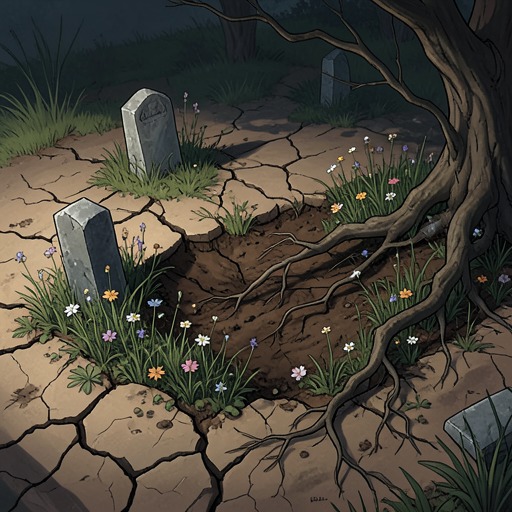
Eva’s garden is described as the wild counterpart to the order of her house. Its fertility comes from what would otherwise be discarded: pot scrapings, tea leaves, cucumber peelings, pumpkin rinds, and old tomatoes are buried or piled into the soil. Seeds from the waste take root unpredictably, and apple trees grow from discarded cores. Eva’s gardening method is to impose no method at all, allowing nature to make its own arrangements. The result is profusion: rosebushes near the channel that collects steer’s blood grow heavy with blossoms, while Eva scatters marigold seeds and feeds oatmeal to birds.
This abundance is not presented as a simple picture of renewal. Schatzie digs up bones buried by a former dog and leaves them scattered through the yard; Delphine imagines them as a disordered collection of human bones, while the garden’s broad leaves temporarily conceal them. Decay and growth occupy the same ground. The garden’s life depends in part on what has been thrown away or has died, and its luxuriance can make mortality more visible rather than erase it.
As Eva’s illness advances, Delphine begins to understand the garden’s untidiness as a form of attention distinct from the carefully ordered household. Eva’s wildness makes room for things to grow without being controlled, but it also confronts Delphine with how brief their lives may be. Delphine, who has not previously gardened or cultivated rituals around birds and plants, finds herself thinking about fate and the improbability of being alive at all. The garden becomes a setting in which mortality is neither abstract nor separate from ordinary care: tending, discarding, feeding, and growing all take place together.
A World That Outgrows Its Defenses
The garden’s ecology includes destructive life as well as nourishing growth. Slugs multiply across the leaves, eating them until only their veins remain. Eva and Delphine try to trap them with beer bottles set into the earth, but Eva recognizes that the creatures are too numerous and too unintelligent to find their way into every bottle. The garden survives not because the threat is eliminated but because there is too much vegetation for the slugs to consume all of it.
The slugs draw snakes into the garden, and the scene widens into a chain of feeding and response: the snakes consume the slugs, while a toad appears in the fading light. Nature is not simply a comforting emblem for the characters’ hopes. Its processes continue on their own scale, indifferent to the limits of human plans. The beer traps, the voracious pests, and the predators moving in from the garden’s edges turn a small domestic task into a visible cycle of appetite, destruction, and survival.
That cycle also sharpens the contrast between Delphine’s hope and Eva’s knowledge of her approaching death. As the garden flourishes, Delphine wonders whether life might surge forward and improve. Eva answers that there is no hope of trapping all the slugs. Her response does not reject life’s abundance; it recognizes that abundance cannot be made safe or completely controlled. The garden can thrive even while its individual plants are eaten, just as life continues around Eva without undoing her illness.
Eva’s Belief in a Larger Pattern
When Eva speaks to her sons about death, she separates the meaning of life from obedience to religious observance. Communion, confirmation, and church rituals may matter to them, but she insists that they do not encompass the larger plan she has glimpsed. She cannot define that plan. What she can say is that it accounts for both immense things and the smallest detail, which she represents by raising her little finger.
Eva asks her sons not to take her death too hard. She imagines that human understanding is only beginning to reach toward what may come next, and describes herself as belonging to a design in which things are continually made from other things. In this account, death changes a person’s form of participation rather than making that person wholly absent. Her image of the pattern gives her sons a way to think about loss without claiming that they can understand what follows it.
The speech is tied to Eva’s physical decline, not offered as a detached philosophical doctrine. After telling her sons what she believes, she drinks water, coughs, and falls asleep. Later, as her illness reaches its end, her body passes through an extended period in which it seems unable either to live or to die. The stark difference between Eva’s confidence in a design larger than human understanding and the drawn-out uncertainty of her dying keeps the belief from becoming an easy consolation: the pattern may be real to her, but it does not make the process clear or painless for those who remain.
Dying, Witnessing, and the Limits of Explanation
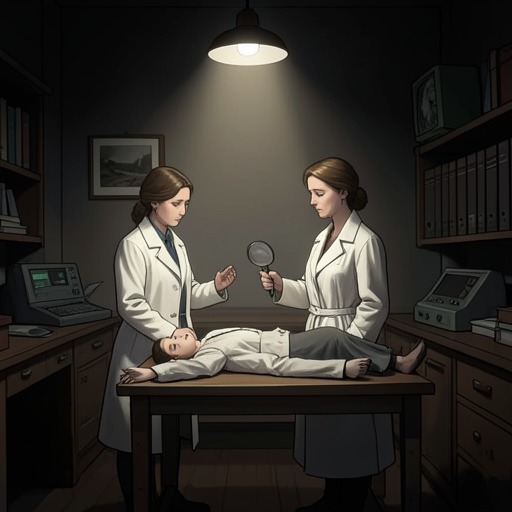
In Eva’s final period, Delphine stays close. She watches Eva’s strength diminish and remains at her bedside through the night when Eva dies. The death is described through a change in breathing and movement, but the experience is also structured around the two women’s sustained attention to one another. Earlier, their eye contact had seemed to pull them beyond ordinary perception, an intense connection that comforted and frightened Delphine. At the end, Delphine does not look away or release Eva’s hand.
Eva had asked Delphine alone to handle her body and to write to her mother, telling her that Delphine had cared for her and that Eva loved her. Delphine’s presence at the death fulfills the request at its most immediate level: she accompanies Eva rather than summoning the rest of the family into the room. When Eva’s breathing stops, Delphine sees the light go out behind her eyes. The scene gives the abstract idea of a continuing pattern a concrete counterpoint in the irreversibility of a particular death, witnessed by the person Eva chose.
Afterward, grief does not end with the funeral or settle into a single explanation. Delphine sees Eva’s sympathetic expression in Schatzie’s eyes and initially fears that she is losing her mind. She then goes outside and speaks to Eva, allowing herself to cry for the first time since the death. The episode leaves open whether the dog’s face carries a supernatural presence or whether Delphine’s grief shapes what she sees. Either way, Eva remains active in Delphine’s perception, and the garden where the two friends had sat becomes inseparable from the memory of their last hours together.
The Dead Among the Living
The novel links Eva’s death to a change in Roy’s life. Afterward, Roy enters an unusually sustained period of sobriety. Eva’s death coincides with a renewed haunting by the Chavers family, whose deaths in the cellar have already burdened him; the apparitions make his fear more difficult to avoid than the terrors of withdrawal. The text does not reduce his change to a single cause: Eva’s death and the returning dead together make his former way of living unbearable.
Roy begins caring for his house and for Delphine’s household. He paints the house, repairs and varnishes its floors, fills the cellar more thoroughly, and makes breakfast while Delphine is occupied with Eva’s sons. He continues to behave well rather than returning to his former drinking, and takes up practical tasks such as tending chickens and protecting them from predators. The consequences of death thus appear not only as sorrow or absence but as altered conduct among the living.
Delphine tells Cyprian that the dead have more power than people know. Her observation can refer to Eva’s continuing presence in memory, to the Chavers’ effect on Roy, or to both. The novel does not require those forms of power to be identical. Instead, it allows the dead to persist through different channels: a remembered relationship, a haunting, an image glimpsed in a dog’s eyes, or a change that takes hold in someone who survives.
Death and the natural cycle therefore offers neither a tidy promise of survival nor a view of death as pure disappearance. Eva’s garden makes decay part of fertility; her speech places individual lives inside a design she cannot explain; and the aftermath shows how the dead continue to shape the habits and perceptions of those around them. The cycle is sustaining, but not gentle: new life does not cancel loss, and continued influence does not restore the dead. What remains is an unsettled coexistence of ending, transformation, and life proceeding in the same ground.